Birds & Fish עוֹף · דָגָה
Day five fills the sky and sea
Day two made a space: sky above, water below. Day three pulled the sea back and let dry land up. Day five is the day God fills what he made. The waters swarm and the sky fills with wings, every kind in its own company. These are ordinary creatures, and the Bible means them. But something happens the moment they are all in place.
Filled, and then blessed. This is the first blessing in the Bible. The light, the dry land, the sun and moon get no blessing. The swarming things get it first, and what they are blessed with is more of themselves: be fruitful, multiply, fill. Two phrases from these verses run through the rest of Scripture. A few lines later, when the man is given his charge, Genesis pairs them: dominion over “the fish of the sea, and over the fowl of the air” (Genesis 1:26, 28).
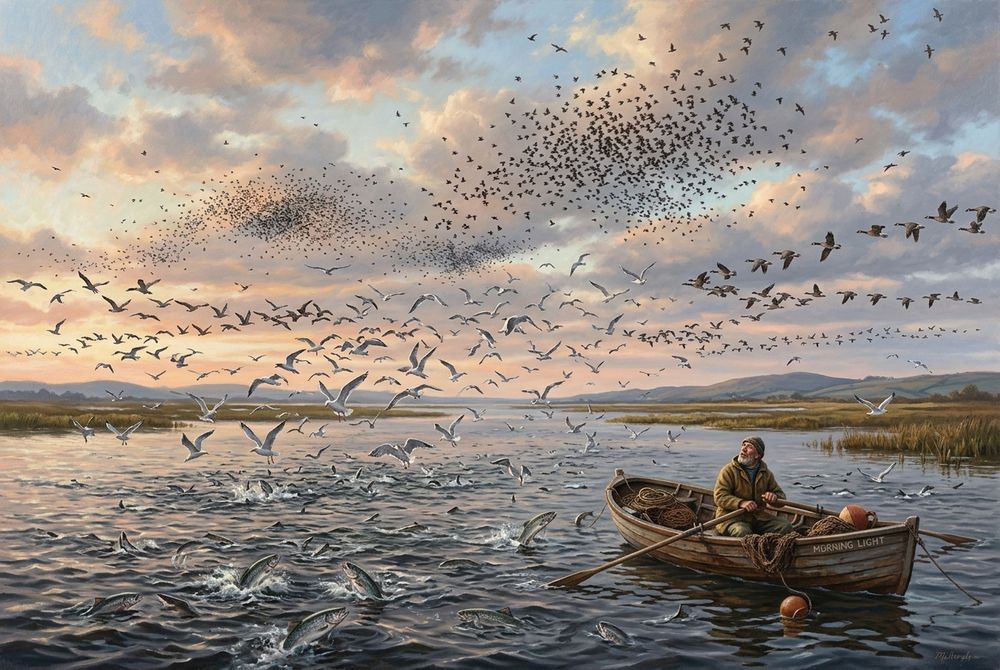
Geese in their V, starlings in their cloud, gulls over the teeming water: every kind in its own company, all under one sky. When Scripture wants to speak of many peoples at once, this is a picture it often uses.
The prophets run day five backward
When a covenant order comes apart, the prophets have a particular way of saying so. They do not only announce that judgment is coming. They empty the realms, and they empty them in creation’s own order, using creation’s own words.
Hosea’s list is Genesis’s list, running out instead of filling up: the land, the beasts, the fowls of heaven, the fishes of the sea.
Zephaniah reads like an inventory being crossed off, line by line: man, beast, fowl of the heaven, fish of the sea. Same categories, same order.
Jeremiah says it inside the strangest vision in the prophets. He looks and the land is “without form, and void,” the heavens have no light, there is no man, and the birds are gone. That phrase, tohu wa-bohu, is Genesis 1:2’s own, laid on a country. And two lines later Jeremiah gives the size of what he is describing: “The whole land shall be desolate; yet will I not make a full end” (Jeremiah 4:27). A planet does not get a remnant clause. A people does. What is coming apart here is a covenant order, the kind of world traced on heavens and earth.
One word ties all four passages together. “Fowl” in Genesis 1:20 is oph. “Fowls of heaven” in Hosea, “fowls of the heaven” in Zephaniah, “birds of the heavens” in Jeremiah: the same Hebrew word in all four. Day five’s fill-list is the prophets’ un-fill-list. The realms and the creatures that live in them are not stage dressing in this book. They are covenant furniture, and when the covenant goes, the furniture goes with it.
Peter’s sheet, and what Peter said it meant
Then a sheet comes down out of heaven, and the creature-categories are inside it.
Beasts, creeping things, fowls of the air, lowered to a hungry man on a rooftop, with an order to kill and eat. Peter refuses, and the voice answers him.
This is the one place on the page where nobody has to guess, because the man who saw the vision says what it was about. Standing inside Cornelius’s house a few verses later, he says it out loud.
The creatures stood for peoples, and the reading is Peter’s before it is ours. He saw animals and he says man, standing in the house he was not supposed to enter. The clean-and-unclean animal lines had marked Israel off from the nations. Peter announces that the marking-off is over, and the nations are coming in. The dividing verb behind those lines, and where Scripture says the dividing was finished, is on hivdil. And this is not the only creature from day five that ends up standing for a nation. The great sea-creatures do it all through the prophets, traced on tanninim.
GO DEEPER: Fishing for people
Fishing for people
There is a second thing Scripture does with day five’s creatures, and it is stranger than the first. It makes people the catch.
God sends fishers, and what they fish for is them, a people. In Jeremiah the sending is judgment. The fishers and then the hunters come for a nation that thinks it can hide, and the next verse says so (Jeremiah 16:17). But the picture is now on the page: boats, nets, a catch, and the catch is human.
That Hebrew word for “fishers” is rare enough to check by hand: it appears in only one other verse in the whole Bible. Ezekiel uses it at the healed sea his temple-river reaches, where the fishers can barely keep up with what the water hands them (Ezekiel 47:10). Same word, opposite job: Jeremiah’s fishers hunt a people down, Ezekiel’s stand at abundance. That healed-sea half of the picture is on the river.
Jesus says it to working fishermen, standing at the water, and the picture turns over. Same trade, same nets, and the catch is still people, only now they are being gathered in rather than hunted down.
A net dropped in the sea, and what comes up is “of every kind.” Day five is the chapter that sorted its creatures by kind, company after company. The kingdom parable puts a net in the water and brings up every kind there is. The echo is there. How much weight it carries is yours to decide.
The Flock wheels in the middle sky, beside the Dragon it swims above.
Open the heavens →Day five records God making the actual fish and birds, and when later books mention fowl and fish, they mean the same animals.
Day five's creatures are real, and the prophets and Peter then reuse its categories for peoples, so the realms are covenant furniture too.
Day five’s birds and fish are birds and fish. In Genesis’s own scene God makes real creatures, blesses them, and means them. Nothing on this page asks you to trade that in for something cleverer.
What the page shows is where Scripture itself puts creatures in for peoples. The prophets’ emptying-lists do it. Peter’s sheet does it, and Peter is the one who decodes it. Those are the places, and the weighing is yours.
Three limits. Peter’s sheet runs on Leviticus’s clean-and-unclean lines, not on day five’s kinds. What it shows is that a creature-vision can be about peoples at all, and that an apostle read one that way inside the story. Jeremiah’s fishers are sent in judgment, not on a mission. Jesus is not quoting Jeremiah; both put people in the net, and that is the whole connection. And the net parable’s “every kind” is a Greek phrase in a Greek Gospel, not Genesis’s Hebrew. The echo is the picture, not the vocabulary. Plenty of readers hear nothing there but ordinary fishing, which was the disciples’ own trade, and that is a fair reading.
One small point of exactness. The bird-word is identical across the four passages above: oph in Genesis, and oph again in Hosea, Zephaniah, and Jeremiah. The fish-word is a close relative rather than the same spelling. Genesis 1:26 uses one form and the prophets use its twin from the same root. Close, but not identical.